The AI Frontier Europe Can Actually Win
The worldwide shutdown of Mythos 5 and Fable 5 confirmed what Europe already feared about its dependence on US AI. The fix everyone's reaching for may be the wrong one.


As of this Friday, the dependency stopped being theoretical.
At 5:21pm, Anthropic received an export-control directive from the US government: suspend access to its two most advanced models, Mythos 5 and the days-old Fable 5, for any foreign national, whether inside or outside the United States, on national-security grounds. Because a restriction keyed to nationality cannot be enforced selectively across a shared cloud, including for the foreign nationals already sitting in San Francisco offices, Anthropic’s own among them, the only way to comply was to take the models down for everyone. So they did. A flagship model went dark worldwide, three days after launch, on the strength of a single government letter.
Other Claude models stayed up, and the company called the order a misunderstanding it expected to resolve. But the lesson did not wait for the details. Overnight, European researchers, companies, and institutions were reminded that a chunk of the infrastructure they had quietly built their work on belonged to someone else, and that someone else answered to a government an ocean away. The reaction was immediate and loud: Europe is dangerously exposed, and it needs its own frontier models, fast.
The exposure is real. The conclusion feels half right.
Europe does need sovereign models. What it does not need is the fantasy attached to that instinct: the idea that sovereignty means matching the American frontier head-on. That is a reflex, not a strategy, and it points Europe straight at the one fight it cannot win while distracting from two it can. The reflex feels like resolve. It is actually a way of losing more slowly.
The fight Europe already lost
Frontier large language models are produced by a capital process Europe has no equivalent of, and wishing otherwise does not change that reality.
The leading labs are not ahead by a few clever ideas that a well-funded European competitor could reproduce. They are ahead by a self-reinforcing stack: tens of billions in compute, multi-year head starts compounding, and, crucially, the ability to fund the next training run out of the cash flows of the last one. This is the part that gets missed in the “we need a European champion” conversation. The American frontier is increasingly self-financing. The race is not a sprint you can enter with a big enough grant. It is a flywheel already spinning, powered by revenue and capital markets that have no European counterpart at the relevant scale.
To try to match that frontier is to pour sovereign money into a depreciating asset. By the time a European model caught today’s leaders, the leaders would be a generation ahead, and the European model would be a very expensive monument to the state of the art eighteen months ago.
Notice the precise claim, though. It is not that Europe should stop building large language models. It is that Europe should stop building them with the goal of winning. Those are different propositions, and collapsing them is the root of the confusion. There is a strong case for sovereign European LLMs. There is no case for a European frontier-LLM moonshot. Holding both thoughts at once is the beginning of a real strategy.
This is not a counsel of despair. It is a counsel of factor endowments: the unglamorous economic idea that you should compete where your inputs are cheap, not where they are scarce. And the moment you look at AI through that lens, the picture inverts.
What frontier LLMs actually consume
A frontier LLM is, in input terms, a machine for converting three things into capability: enormous compute, enormous quantities of (scraped) web-scale text, and the capital to keep buying both.
Look at that list from Brussels and it reads like an inventory of everything Europe is short of. Hyperscale compute? Concentrated in American and Chinese clouds. The open web’s text, and the legal-commercial machinery to hoover it up? Dominated by firms outside Europe. The capital markets that fund nine-figure training runs as a routine cost of doing business? Not here, certainly not at this scale.
This is why trying to win the frontier-LLM race is a trap. It is precisely the contest that rewards the inputs Europe lacks and penalizes the absence of inputs Europe cannot quickly manufacture. You could not design a competition more perfectly tilted against European strengths if you tried.
So the interesting question is not “how does Europe win the LLM race?” It is this: is there a frontier where the binding constraint is something Europe actually has?
There is. But naming it requires walking into one of the messiest words in the field.
A word that means three things
“World model” is having a moment, and like most terms having a moment, it has been stretched until it means whatever the speaker needs it to mean. Before it can do any work in an argument, it has to be pinned down, and pinning it down turns out to be unexpectedly useful, because the confusion is itself revealing.
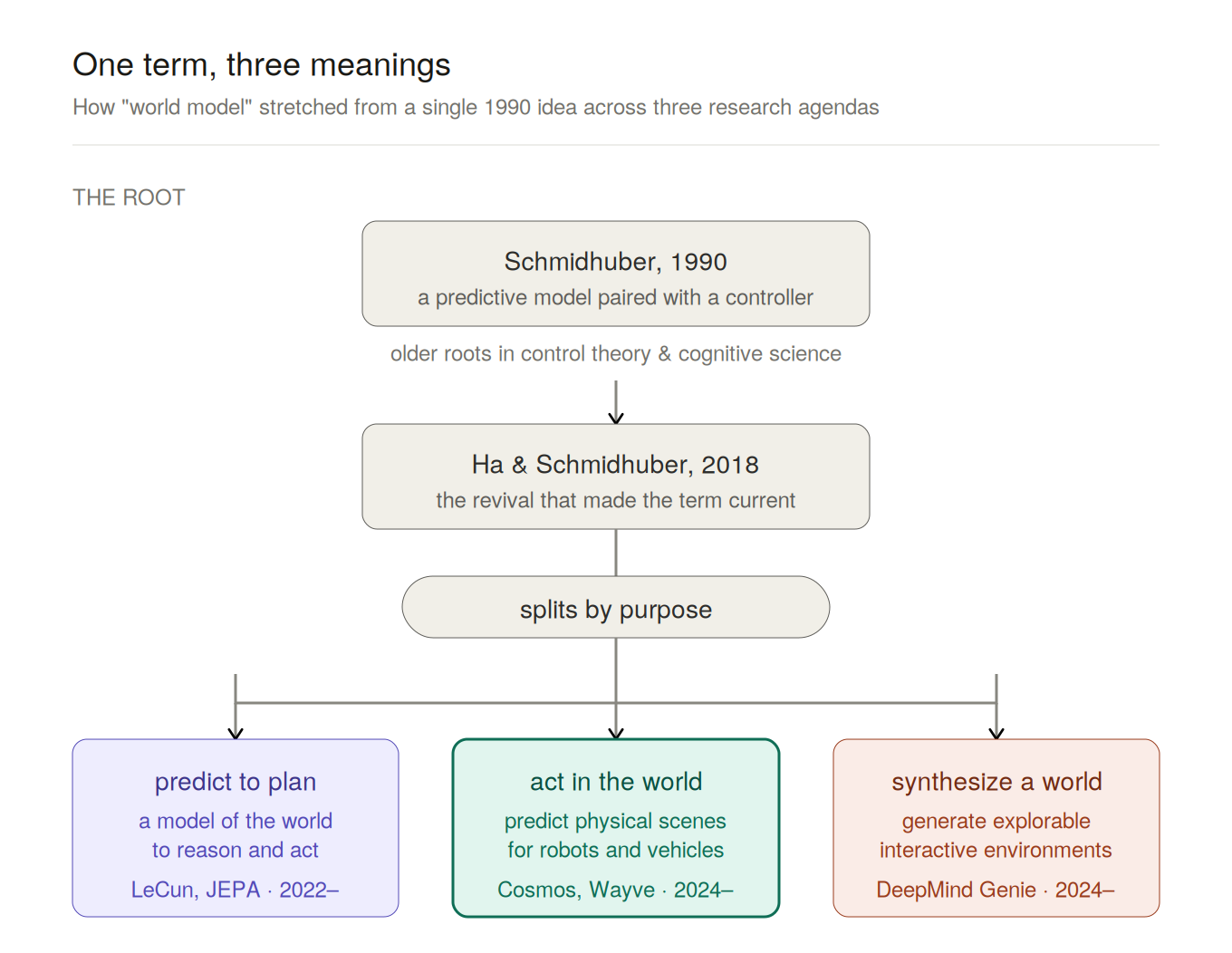
The “World Model” confusion: Three senses, one word, no shared definition. This piece uses the middle one, world models as predictors of physical scenes, because its bottleneck is proprietary real-world data, not the compute and web text the other senses compete for. That is the input Europe is least short of.
The idea is older than the hype. It traces, in its modern form, to a 1990 proposal from Jürgen Schmidhuber: pair a model that predicts what the environment will do next with a controller that acts on those predictions. The roots run deeper still, into control theory and the cognitive-science intuition that an intelligent agent carries an internal model of its world in order to plan. In 2018, a paper by David Ha and Schmidhuber revived the term and made it current, showing an agent that could be trained inside its own learned “dream” of an environment.
From that single root, the term has since splintered across three research agendas that mostly do not talk to each other, which is exactly why it confuses anyone trying to follow the field.
One sense is about prediction as the path past today’s AI. This is the camp, associated with Yann LeCun and the JEPA line of work, that treats world models as the architecture that gets machines beyond the limits of language models: intelligence as prediction and planning in a learned, abstract space rather than next-token pattern-matching. Here, “world model” is a bet about the future of general intelligence.
A second sense is about acting in the physical world. This is the world model as the substrate for robots and autonomous vehicles, a system that predicts how a physical scene will unfold so a machine can move through it. Nvidia’s Cosmos “world foundation models,” pitched explicitly at physical AI, sit here; so does a company like Wayve, betting on learned driving. The defining feature of this sense is its appetite: it runs on proprietary, physical-world data, the motion and manipulation and navigation footage of reality, not on scraped text.
A third sense is about generating worlds to explore. This is the world model as a kind of neural game engine, DeepMind’s Genie line, which conjures navigable, interactive environments from a prompt. Related to text-to-video, but distinguished by interactivity: you don’t watch the world, you move through it.
Three senses, one word, no shared definition. Each agenda reached for the same evocative term, partly, one suspects, because all three like to describe themselves as a step toward general intelligence, and “world model” carries that grandeur for free. They are not rivals fighting over territory so much as strangers who happened to move into the same house.
It is worth noting that the senses are beginning to share machinery even as their purposes stay distinct. Nvidia’s Cosmos uses the generative techniques of the third camp to serve the second camp’s robots. That convergence makes the shared vocabulary more misleading, not less, which is all the more reason to be explicit about which sense is in play.
This essay means the second one: world models as predictors of physical scenes, the substrate for embodied machines. Not because the other senses don’t matter, but because this is the one whose binding constraint is the input Europe is least short of.
The fight Europe could actually win
Set the two frontiers side by side and the asymmetry is stark.
The frontier-LLM race rewards compute, web-scale text, and capital, which are Europe’s scarcities. The embodied-world-model race rewards something else: proprietary physical-world data, deep domain integration, and the industrial and scientific assets to generate both. And that list reads like an inventory of European strengths.
Consider what is actually here. Europe’s industrial-robotics and factory-automation base, the accumulated and decades-deep know-how of motion control, actuation, and real deployment on real factory floors, is precisely the kind of physical-world competence that cannot be scraped off the internet. Its automotive sector and the supplier ecosystem around it have spent years building high-fidelity driving simulation, sensor-fusion stacks, and digital twins; Wayve is the cleanest example of a European firm betting directly on driving as a learned, world-model problem. And its scientific-modeling tradition is, in places, genuinely world-leading. European weather forecasting’s machine-learning work is among the best on the planet, and institutions across fusion, particle physics, and materials science are fluent in exactly the task a world model performs: predicting how a complex physical system evolves.
The connective tissue across all three is the thing that matters strategically. In each case, the bottleneck is proprietary, physically-grounded data and the domain expertise to use it, not the web-scale text and hyperscale compute that the LLM frontier runs on. This is the axis along which Europe’s dependency is lowest. It is the one frontier where Europe’s structural position is an advantage rather than a liability.
A caveat worth stating plainly, because it is the place a sharp reader pushes back: this is an argument about where the comparative advantage lives, not a claim that Europe is already winning. Several of these are assets adjacent to world models rather than world-model programs as such. The case is that Europe is unusually well-positioned to build them, not that the race is already run. And it is a narrowing window, not an empty field. The US and China are pushing hard on robotics and embodied AI too. Europe’s specific edge is not in general-purpose humanoids, where capital advantages reassert themselves, but in the deep industrial and scientific verticals where the relevant data is hard to replicate and already sits inside European firms and institutions. That distinction is the whole game.
Two moves, not one
This is where the sovereignty conversation needs to split a single panicked instinct into two distinct strategies, because they answer different questions.
The first is defensive, and it is the one the chokepoint genuinely justifies. Europe should build sovereign LLMs, but the goal is not to win benchmarks. Rather, it is to hold a controlled, good-enough capability that cannot be switched off from abroad. A second-tier sovereign model is not a failed frontier model. It is insurance, and insurance is not supposed to outperform the thing it protects against. Judged as a championship contender, a European LLM is a disappointment. Judged as a hedge against exactly the dependency that just made itself felt, it is the rational minimum. The mistake is conflating the two and then feeling humiliated that the hedge is not a contender. Good enough and sovereign is the target. Frontier-or-bust is the delusion.
The second move is offensive, and it is where ambition belongs. Bet on the embodied frontier. Fund it where Europe’s comparative advantage is real, in the industrial, automotive, and scientific verticals where proprietary physical data and domain depth are the binding constraints. Sovereignty as insurance, world models as offense. The first keeps Europe from being held hostage. The second gives it something worth being un-hostageable for.
Don’t panic, this is not a white paper
What this implies for policy is less a program than a change of target, a few directions worth more than another doomed champion.
Treat physical-world data as strategic infrastructure. The advantage here lives in proprietary datasets (factory floors, vehicle fleets, scientific instruments) and the default trajectory hands that data, and the rent-setting power over it, to whoever provides the modeling layer on top. The procurement and data-governance questions that decide who captures that value are not back-office details. They are the sovereignty fight, arriving one layer down from where everyone is currently looking.
Fund the verticals, not the vanity. Money aimed at a general-purpose European frontier model is money aimed at Europe’s weakness. The same money aimed at embodied and scientific world models, at robotics, autonomous systems, simulation, and physical-AI foundations tied to existing industrial and research strengths, is aimed at its strength.
And stop measuring success against the wrong scoreboard. As long as European AI policy grades itself on proximity to the American frontier, it will keep losing a race it entered by mistake, and keep underfunding the one it could lead.
The dependency that surfaced that Friday evening was a genuine warning. But the answer to “they can cut us off from their frontier” is not “build a slower copy of their frontier and call it parity.” It is to build a sovereign capability good enough to absorb the shock, and then to put the real ambition where the ground actually favors you.
The illusion of borderless AI is over. That much the alarmists have right. What they have wrong is the response. The point is not to win the last war faster. It is to notice which war is still open.
Related reading: Why Your AI Bill Is About to Look Very Different and What DeepSeek’s 75% Price Cut Says About the Real Cost of AI.