

In the space of about seventy-two hours this week, the publisher side of the AI fight produced more visible momentum than it had in the previous year.
At the World News Media Congress in Marseille, the SPUR coalition — the Standards for Publisher Usage Rights group launched in February by the BBC, Financial Times, Guardian, Telegraph, and Sky News — announced it had added some thirty new members and secured formal backing from WAN-IFRA, which represents roughly 3,000 news organizations across 120 countries, and FIPP, the global magazine-media association. On the same stage, Guardian editor Katharine Viner named AI-driven disintermediation, or rather the severing of the link between a publisher and its readers, as the one threat she would not hedge against, and pointed to SPUR as the collective answer.
And in London, the Competition and Markets Authority did something no regulator had done before. It ordered Google to let publishers opt out of having their content used in AI Overviews and AI Mode without losing their place in ordinary search results. CMA chief executive Sarah Cardell called it a “world-first requirement” meant to give publishers “appropriate bargaining power over how their content is used.” Google was also ordered to attribute publisher content with clear links in its AI results.
Taken together, the week reads like a counteroffensive finally taking shape: a publisher coalition scaling up, a major regulator breaking the most important logjam, and one of the world’s most respected editors naming the stakes plainly. The trade press greeted it accordingly.
I want to suggest a more careful reading; not a cynical one, because the progress is real and very encouraging, but one that asks what each of these moves actually does, and what it conspicuously leaves unfinished.
A couple of weeks ago I argued that the publisher response to AI was missing a specific institutional piece — that the enclosure of the open web was happening across three distinct layers, and that the interventions on offer addressed some layers while leaving the decisive one untouched. The events of this week are the clearest test of that argument so far. They cut both ways, and the way they cut is instructive.
What the CMA actually changed
Start with the regulatory news, because it’s the most consequential and the most misunderstood.
The single biggest structural obstacle to a functioning publisher-licensing market has been what the writer Joshua Benton, at Nieman Lab, called the fundamental blocker: Google’s refusal to separate its search-indexing crawler from its AI-training crawler. As long as appearing in Google Search meant submitting to AI ingestion, the price a publisher could charge for that ingestion was effectively zero — because the alternative was disappearing from search entirely. News Media Europe, in its submission to the CMA, called this “compelled consent”: allowing the crawl is the price of visibility, and the same content then powers the AI features that erode the traffic visibility was supposed to provide.
The CMA just broke that coupling, in one jurisdiction, by force of regulation. UK publishers will be able to refuse AI use while keeping their search presence. On the logic of the licensing market, this matters enormously as it is the first time the “Hobson’s choice” at the heart of the publisher complaint has been pried open by anything other than a private lawsuit.
But notice three limits, each of which the celebratory framing tends to skip. The remedy is confined to the UK and to Google; the scraper economy and the other AI labs sit entirely outside it. Google has nine months to comply, and as one analyst noted, a harm running for three years now continues un-remedied until late 2027, with effectiveness unknown until then. And most importantly: an opt-out is a shield, not a revenue stream. The right to say no to Google’s AI is not the same as the ability to be paid by anyone for saying yes. It restores leverage. It does not, by itself, cut a single deal.
What SPUR is — and what it is careful to say it isn’t
Which brings us to the coalition news, and to a sentence worth reading closely. As John Rahim of The Media Stack put it, SPUR "isn't a licensing body and doesn't cut deals on anyone's behalf. What it's building is the layer underneath the deals."
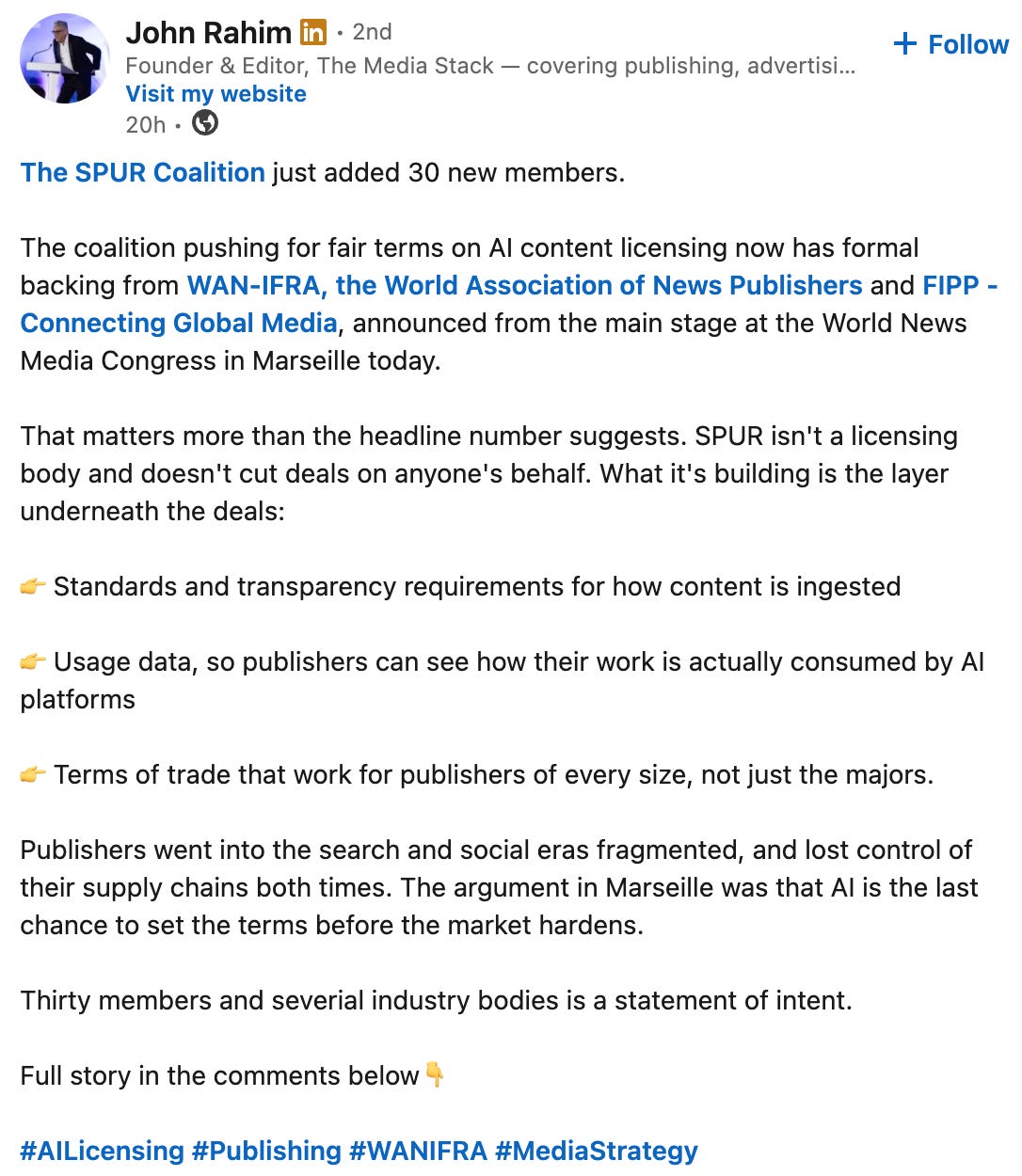
That is an accurate and honest description, and it is also the whole problem in miniature.
The layer underneath the deals (shared standards, machine-readable terms, transparency requirements, usage data so publishers can see how their work is consumed) is genuinely valuable infrastructure. It is the grammar a licensing market needs in order to function. Building it across a coalition that now spans national broadcasters, global wire-adjacent publishers, and two of the largest trade bodies in the industry is real, hard, useful work.
But a grammar is not a counterparty. Standards describe how a deal should be structured; they do not sit across the table from OpenAI or Google and negotiate price, and they do not collect and distribute the money afterward. SPUR has said, clearly and to its credit, that this is not what it does.
So the question the week’s coverage mostly glides past is the obvious one: if SPUR builds the layer beneath the deals, and explicitly doesn’t cut deals — who does?
The layer nobody has built
Survey the field and the answer, for most publishers, is: still no one.
The major publishers cut their own deals. News Corp, the New York Times, Axel Springer, Reuters — these institutions have the brand leverage, the legal departments, and the senior relationships to negotiate bilaterally with AI companies, and several have. For them, better standards (SPUR) and restored leverage (the CMA) are accelerants on a process they were already capable of running. They were always going to get the meeting.
Below that tier, the deal-cutting function exists only in fragments. Dow Jones’s Factiva aggregates thousands of sources and negotiates on their behalf — a centralized model, governed commercially by Dow Jones. The News/Media Alliance has built templated arrangements with AI partners where members contract individually under a shared legal framework. And the infrastructure players — Cloudflare’s pay-per-crawl, Microsoft’s

Publisher Content Marketplace — operate the only at-scale marketplaces that actually move money, but they are governed by the platforms, not the publishers, with rent-setting authority sitting on the wrong side of the table.
None of these is what SPUR is, and SPUR is not trying to be any of them. Which means the architecture now taking shape looks like this: a publisher-governed standards layer (SPUR) sitting above a set of deal-cutting mechanisms that are either elite-only (bilateral), commercially governed (Factiva), structurally limited (NMA’s templated bilaterals), or platform-governed (Cloudflare, Microsoft). The standards layer and the deal-cutting layer are being built by different actors, on different governance logics, and it is not at all clear they are designed to interlock.
For the publisher this entire exercise claims to serve — the regional daily, the mid-sized digital native, the specialist trade title, the independent investigative outlet — the practical question is brutally simple and almost entirely unanswered: when an AI company trains on my work, who negotiates on my behalf, and who makes sure I get paid? SPUR’s standards don’t do it. The CMA’s opt-out doesn’t do it. A bilateral deal isn’t available to me. Factiva might, if I qualify and accept its terms. Otherwise, the answer is the same as it was a year ago.
Why “thirty members” and “trade-body backing” don’t settle it
It’s worth being precise about the inclusion question, because the headline numbers invite a misreading.
Thirty new SPUR members announced at an event attended by the executives of major publishing houses are, in all likelihood, still substantial publishers — national and large-regional outlets, international groups, significant magazine brands. “Thirty members” can describe thirty of the largest two hundred publishers in the world and still represent the apex of the industry, not its long tail.
And trade-body endorsement, however valuable, is not membership. WAN-IFRA representing 3,000 organizations does not place 3,000 organizations inside SPUR’s arrangements, much less inside anyone’s licensing deals. It signals legitimacy and opens a recruitment channel. It does not enroll the small publisher, and it certainly does not negotiate or collect on that publisher’s behalf. The distance between “my trade association endorsed this initiative” and “I receive a payment when a model trains on my reporting” is the entire unsolved distance.
There is even a quieter bias built into the standards-first approach. Machine-readable standards, however open, are adopted most readily by publishers with the engineering capacity to implement them. The large publisher has a team for that. The small one often does not. A universal standard, in practice, tends to deliver its benefits first and most fully to those who already had resources — which is the opposite of what the long tail needs.
The question the week made visible
None of this is an argument against the week’s developments. The CMA ruling is the most important regulatory move yet made on behalf of publishers, and the precedent may travel well beyond the UK. SPUR’s expansion is a genuine act of collective will in an industry not known for solidarity. Viner naming disintermediation as the threat she won’t hedge against is the most clear-eyed thing a major editor has said about AI in months.
But momentum is not the same as resolution, and the shape of what’s been built tells you precisely what hasn’t. The week produced a stronger standards layer and a stronger leverage position — the layer beneath the deals, and the right to walk away from a bad one. What it did not produce, and what no announcement this week even claimed to produce, is the thing in the middle: a publisher-governed mechanism that actually negotiates and collects on behalf of the publishers who cannot do it themselves.
The standards are arriving before the entity that would make them pay off for anyone without their own business-development team. Whether that entity gets built, and whether the economics of the long tail can even support it, is the question all this week’s progress quietly sharpened rather than answered.
It is the question worth watching and one I’ve spent years thinking about. The news will keep coming fast; the announcements will keep sounding like victories. The thing to ask of each one is the same: does this finally cut the deal for the publisher who can’t cut it alone, or does it build one more layer around the place where that deal still isn’t being made?
For the longer argument this builds on — the three-layer enclosure of the open web and why the publisher-side broker is the missing piece — see below:
